Live Coverage? Here.

Breaking News


LV Cup

10 March 2010

10 Mar, 2010

Gear failure puts finish to a close
Kiwi vs Italian encounter

American-based Kiwi Gavin Brady and his largely international team of Latin Rascals took the fight to host Emirates Team New Zealand in their Louis Vuitton Trophy race today, only to lose after a gear failure.

© Ian Roman/TEAMORIGIN | Louis Vuitton Trophy

Brady, with American tactician Morgan Larson calling the shots, pulled off a risky pre-start strategy against skipper Dean Barker on the New Zealand boat, pushing ETNZ deep into the start box after a dialup but breaking clear with immaculate timing to grab the start he wanted - a port tack cross at speed, right at the committee boat.

Minutes later as they came back together, Brady had a two boat-length advantage that he parlayed into a 22 second lead at the first weather mark. Down the run, the New Zealanders split away and Brady let them go, only to concede the right side of the course when they rounded opposite gates starting the second beat.

Brady's lead had evaporated but the fight had just started. Half way up the weather leg Mascalzone barely had her nose in front as they sailed into a building breeze when the jib came crashing down. "That was our race to win," said Brady. "And a tough way to lose!"

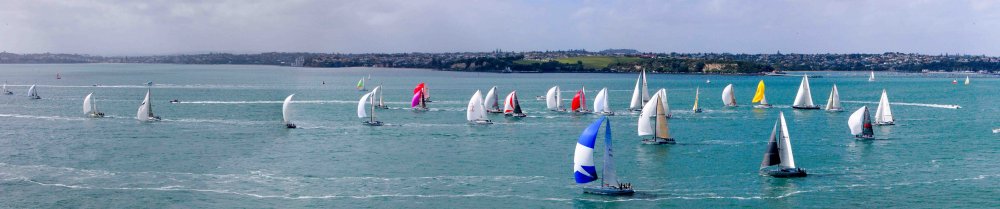
Out on the Waitemata Harbour today, the wait for a good breeze stretched out to three hours but the competitors were rewarded with superb sailing conditions under a bright sunny sky. The sea breeze filled in from the southwest, starting at five to seven knots and building during the afternoon to nearly 15 knots before softening a little in the late afternoon.

The boats raced on 1.2-mile legs on the black course, bounded by the Devonport shore and the natural grandstand of North Head on one side and Bastion Point on the other. Spectators high on North Head were rewarded with birds-eye views of the competition.


Race One: TEAMORIGIN def. All4One, 01:33 - Britain's TEAMORIGIN, skippered and steered by Ben Ainslie, prevailed in the pre-start to lead Sébastien Col at the wheel of All4One at the gun with a 16-metre margin. Sailing at speed on port tack, the British boat started right at the committee boat while their adversary tacked off to starboard behind them. When they converged at the first cross, Ainslie had converted his lead in the shifty breeze to 70 metres. The German/French boat stayed relatively close until the second weather mark but lost a minute on the last run.

Race Two: Emirates Team New Zealand def. Mascalzone Latino Audi, 4:43 - Gavin Brady, the Kiwi skipper of Italy's Mascalzone Latino Audi Team took the fight to the home team, overcoming Dean Barker's starboard entry advantage. Brady came out unscathed in several close pre-start encounters to win the start and the right side of the course. With the breeze up to 11 knots, Brady led Barker by a boat length at the first cross. The visiting team exploited the power of the right to lead at the top mark by a boat length and then extend on the run. Barker fought back, closing down to eight seconds at the leeward mark and getting out to the right. After two very close tacks, the visitors were fighting to maintain a safe leeward berth on starboard when a halyard clip failed and Brady's hopes crashed, along with the jib.

Race Three: Azzurra def. Synergy Russian Sailing Team, 00:41 - The Russian boat steered by Karol Jablonski secured a safe leeward as the boats started, forcing Francesco Bruni on Azzurra away soon after the gun. Jablonski followed and held a one boat-length lead on a long port tack before Bruni tacked back. A tacking duel followed in 12 to 14 knots of breeze as the Italians whittled away the Russian lead, gaining a metre or two on every tack.  As Jablonski tacked to leeward for the tenth time, Bruni had gained the advantage and sailed his opponent out to the layline. The Russians kept it close but the young Italian team eked out more time on every leg.

Race Four: Artemis def. ALEPH Sailing Team 01:21 - Bertrand Pacé and his ALEPH Sailing Team trailed by 50 metres over the starting line in this match and that was all the margin Artemis would need to dominate the race. It appeared to be a miscalculation on time and distance to the start on the French boat, and with Artemis helmsman Terry Hutchinson hitting the line with speed, his Swedish team was in firm control all the way around the track.


Provisional leaderboard after Flight Two:

Emirates Team New Zealand, 2
Azzurra, 2
TEAMORIGIN, 1
Artemis, 1
All4One, 1
ALEPH Sailing Team, 1
Mascalzone Latino Audi Team, 0
Synergy Russian Sailing Team, 0

LIVE Sport Sailing 103.0 FM is featuring all-day live coverage of the Louis Vuitton Trophy.  On television, during the seven days of the round robin, TVNZ is carrying nightly reports on its sports news. From March 16, during the elimination rounds, TVNZ will feature nightly half-hour reports. For the finals on 20th and 21st March there will be live coverage of the racing from noon to 4:00pm.


Photos from Chris Cameron:


Here's Des

10 March 2010


Moth Worlds

10 March 2010


March 09, 2010 - RACING - SailTube

Moth Worlds - Andrew

Day one of the Puma International Moth Worlds conditions proved to be diffcult with the fleet spreading far and wide across the horizon. Many struggled to foil resulting in those that did took the lead, as the wind filled in from the right the boats soon sped up. Weight and foiling were definately a huge factor in finishing places.

The fleet sailed one race today, the course being a standard windward leeward course, three times around, each leg a mile in length. The conditions on day one were calm waters with 6-8 knots of breeze, a bit light for the moths. The light wind speed made it difficult for sailors to get up, and stay up on their foils. Andrew 'Amac' McDougall (AUS) lead the first beat and finished Race 1 with a bullet. Michael Lennon (GBR), Brad Funk (USA), Chris Graham (UAE) and Simon Payne (GBR) rounded out the 44-boat fleet.

During the beats the pressure was favoured on left however most sailors to took the right. Downwind paid to sail left as the pressure was stronger.

The event is shaping up to be a battle of wits, weather and worldliness. With a forecast that is fairly typical- light to moderate breeze, generally flat water and the likelihood of at least a few low-riding (off the foils) races, time will prove interesting results over the course of this week.

Results:
1st Andrew McDougall
2nd Mike Lennon
3rd Brad Frank

1st Junior Alex Burger

1st Women Lindsey...


LV

10 March 2010

09 Mar, 2010

Azzurra delivers stand-out performance on opening day

Azzurra, the Italian boat with the old name and the young crew, defeated Britain's TEAMORIGIN in the closest of four hard-fought races on the opening day of the Louis Vuitton Trophy Auckland.

© Bob Grieser/outsideimages.co.nz | Louis Vuitton Trophy

Italian skipper and helmsman Francesco Bruni snatched a victory from Britain's three-time Olympic gold medallist Ben Ainslie at the first weather mark of their race as their boats rounded the mark overlapped. Sailing above the mark, Ainslie tried to luff his opponent only to see the Italian execute a swift spinnaker set, sail clear and go on to win.

"Azzurra sailed a good race today, they seem to have a knack of overtaking us which is getting very frustrating!" Ainslie said. "We were fully in contention at the top mark and tried to hold them up, we were unfortunately set up for a gybe set and they were set up for a straight hoist which allowed them to gain some distance."

In their efforts to stay on schedule, the race committee spent a long first day on the water. In the morning, cloudy skies killed any chance of a sea breeze developing and delayed racing. The Rangitoto Channel entrance to Auckland Harbour was so glassy at late morning that Principal Race Officer Peter Reggio joked that it appeared to have been paved.

The long wait for wind ended at 2:45pm as the first pair started on the Blue Course at the mouth of the channel between Rangitoto Island and the Takapuna cliffs.  The breeze was five to seven knots from the northwest. After a second race in similar conditions, the breeze switched to the south for the third race inside the harbour. The last race didn't start until 7:10pm and finished after sunset just before 8:00pm

Race One:  All4One def. Mascalzone Latino Audi Sailing Team, 00:44 - In the draw last night, the German/French boat All4One chose the starboard entry for the start and they protected the right side in the pre-start today. They split before the gun with All4One going out to the right on port tack, while Mascalzone Latino Audi enjoyed an early lead on starboard. All4One skipper and strategist Jochen Schümann said a man up the mast had spotted wind out to the right and they chose to concede an early lead to reach the stronger pressure. All4One eventually tacked to starboard to cover and Gavin Brady steering the Italian boat initiated a tacking duel. However Sébastien Col on the helm of All4One had already worked out to a controlling lead on the right that he never relinquished.

Race Two: Azzurra def. TEAMORIGIN, 00:53 - Great Britain's TEAMORIGIN enjoyed the starboard entry in its match against Italy's Azzurra and used it to advantage in a dialup that took both boats well above the line before they sailed back with Ben Ainslie on the British boat chasing Italian Francesco Bruni. Ainslie grabbed the right as they split away at the gun but Bruni kept it close and when they crossed for the first time Ainslie on starboard came down and hunted the Italian who tacked close to leeward and forced the British boat away. It happened again before they came into the weather mark overlapped, with Ainslie holding his opponent out from rounding. They tacked above the mark and the British boat luffed the Italian until Bruni capitalized on a miscommunication on Ainslie's boat. Bruni was first to set a spinnaker and rolled over TEAMORIGIN forcing the British boat to gybe away. From there the Italians controlled the next three legs, finishing with a comfortable 53 second margin.

Race Three: Emirates Team New Zealand def. Artemis, 01:40 - Dean Barker overcame the handicap of a port entry in the pre-start to grab the right side of the course off the start line. Strong outgoing current and shifty breezes played a major role as Terry Hutchinson steering Artemis took the fight to Emirates Team New Zealand but trailed by 55 seconds at the weather mark.  Artemis came charging back on the run to close within 12 seconds at the leeward gate but then lost ground in lighter air under North Head. The Kiwis extended to win comfortably.

Race Four: ALEPH Sailing Team def. Synergy Russian Sailing Team, 03:26 -
The Russian boat steered by Karol Jablonski dominated Bertrand Pacé's French entry in the pre-start only to see ALEPH wriggle clear and lead by three boat lengths at the gun. Jablonski kept it very close, pressuring Pacé on the first beat and was only 11 seconds astern at the top mark. As the sun set over the Auckland City skyline it was also sunset for the Russians as they ran over their spinnaker at the leeward mark. The French sailed away to a comfortable victory.

LIVE Sport Sailing 103.0 FM is featuring all-day live coverage of the Louis Vuitton Trophy.  On television, during the seven days of the round robin, TVNZ is carrying nightly reports on its sports news. From March 16, during the elimination rounds, TVNZ will feature nightly half-hour reports. For the finals on 20th and 21st March there will be live coverage of the racing from noon to 4:00pm.


Live streaming web coverage of the Louis Vuitton Trophy in Auckland is available on the event website, www.louisvuittontrophy.com. The official site (in English, French, Italian and Russian) is also rich in teamcontent, as well as features, audio, video and images.


And some photos from Chris Cameron:


And this:


This Is a Sailboat??

9 March 2010

From Latitude 38:

A megayacht
A appears to be massive in this photo, compared to one of 'grandpa's mega motoryachts' as seen in the background. But in this case, appearance is reality, as A is 390 feet long and 60 feet wide.
Photo Latitude / Richard
© 2010 Latitude 38 Publishing Co., Inc.

Looking at the photo of A, some of you are probably saying to yourself, "If A is a sailboat, where are her mast(s)?" Well, A is one of the new Transformer series of maxi sailboat designs that are able to switch from maximized powerboat to maximized sailboat and back. The reverse bow - a style that has become oh-so-popular these days - triple flips aft and under to become the keel when sailing. And three 195-ft masts - just short enough to make it beneath the Bridge of Americas in Panama - telescope out of the deck to create a Dyna Rig system as pioneered on Tom Perkins' 289-ft Maltese Falcon. The twist is that the massive yards flop into position transformer-like. It's a miraculous bit of engineering that owes a huge debt to the design of toys. As you might imagine, there have been teething issues, but isn't that true with all boats?

A bow shot
Thanks to today's incredibly efficient systems, A and her 14 guests only require 42 crew. And thanks to her telescoping masts, A only carries 200,000 gallons of fuel, making her a real 'green machine'.
Photo Latitude / Richard
© 2010 Latitude 38 Publishing Co., Inc.


A Transom
The width and steep incline of A's transom make it an ideal waterslide.
Photo Latitude / Richard
© 2010 Latitude 38 Publishing Co., Inc.


- latitude / rs


"Modern" Gaff Rig

9 March 2010

If you scroll down the page a little there is a piece on John Wellsford's newest design. I was intrigued by his comments on an updated gaff rig and how he was impressed by its performance

Awols current speed record by the way is 15.4 knots ( GPS) and David feels that there is a lot more to come!

  . So I asked him to explain:


I have long had ideas about making a gaff rig really work well by using some of the modern materials together with the sail shape controls we use on bremudian rigs, and watching the evolution of the "square head" rigs on multihulls and very high performance monos, plus speaking at length to some of my past colleagues at the Marine Design course at Massey Uni and  people who've been involved with the wind tunnel that Team New Zealand uses, came to the conclusion that there were certain issues around proportion, luff length, control of sail shape and aerodynamic cleanliness ( low drag) that might surprise those wedded to the usual shaped sail.

AWOLs rig incorportates my current take on all of those, you'll see that there are no gaff jaws, no lacings on the main luff, ( all in an internal track on a conventional alloy mast section)  and a combination of full battens and comparitively powerful controls on outhaul, luff tension, gaff peak halyard and throat halyard.  There is also a very powerful vang and a full width traveller, neither of which are found on a conventional gaffer.  The result is that the top end of the main is not far off the elliptical shape of the idealised birds wing, and even closer to the wing of the high performance hand launched glider model aircraft which is a very well researched foil and wing shape on a "vehicle" that has to cope with wide variation in wind speeds.

The rig has a lower center of effort than a conventional bermudian sail, so has less heeling moment for the sail area, important with this boat as when singlehanded in bad weather the skipper will want to sit "in" rather than stack out on the side decks, and as he is not a heavy guy the lower heeling effect is beneficial, I can use more area than otherwise which helps in light weather and when reaching or running.


The pros, short mast which makes it easy to rig singlehanded, can sneak under some bridges, ( remember this is primarily a cruiser) can be entered and raced in classic and trad boat regattas, and the rig is unusually powerful when reaching and running.  Its a much better performer than people expect, and that makes her a bit of a Q Ship which is fun.

Practical considerations are cost, the spar is straight with no taper and a second hand mast section from a small trailer sailer or biggish dinghy would do the job, plus its relatively short so is easy to stow when on the trailer.

PLUS,  it makes the boat very very distinctive, different, something that attracts a lot of attention, all good.

In this case the customer wanted to stay with a somewhat traditional style, and although the hull is somewhat reminiscent of about 1970s appearance, the rig changes that into a modern classic with its own appeal.

Skipper Dave tells of people running along the beach to come and have a look, not many boats pull that sort of attention.


Cons, a little more weight aloft, still not quite as clean aerodynamically as a high performance bermudian main, another halyard and a little more complication. 


Mostly though, the boat, and rig, is designed with function first, style second.  But bear in mind that some of the functions are not immediately apparent, the lightweight crew, the low "air draft" ease of rigging, and so on.

 Performance is looking very promising, a friend of mine, out in his Townson 25 spotted AWOL on the water on Sunday last, turned to chase him and said that the little gaffer went away from him so fast he was sure that there was something wrong with his boat.

I'm very pleased so far, am keen to cadge a ride sometime soon so I can observe it in action, and am watching with interest so I can develop the theory further.

I've attached four pics if you can use them, the ones on the beach should be credited to AWOLS builder David Perillo, the one sailing at sea to John Bertenshaw.

John Welsford"


Waterloo

9 March 2010

From YNZ Briefings:


Of Interest

Floating Loo

Have you ever been out on the water and wished there was a toilet you could use?

As most of you know when competing at yachting regattas there can be between 10 and 400 boats, which give anywhere between 10 - 800 competitors, the time they spend on the water can last from one to twelve hours.  Hydration is essential so you need to drink lots which can result in needing to go to the toilet numerous times throughout the day. In some venues the race course is an hour away from the shore making it very difficult for people especially women to go to the toilet.

Muritai Yacht Club member, Nichola Trudgen is proposing a solution to this problem and she wants to know your thoughts. 

"The main aim is to design a portable toilet for people who are in a watercraft on the water.  The primary users will be sailors competing at an event whose boat or dingy does not have toilet facilities," says Nichola.  "This ideally 'floating toilet' will also be used by other members of the yachting event such as rescue boat drivers and race officials." 

Her solution is the 'Waterloo' a toilet which floats and can be easily approached by a yacht or other similar vessel.  It can be towed by a power boat and can be anchored or secured in one place.  It is easy to transport and has two toilets which are easy to use. 

There are two main parts to the 'Waterloo', there is the toilet area which includes the toilet and surrounding walls and the pontoon on which the toilet sits.  These two components have been specifically designed to meet the needs of the end users and also work with the surrounding environments.  The diamond shape of the pontoon makes it easy to approach and tow as well as staying into the wind.  The toilet block is designed to deflect the wind and contain a simple toilet system.  The majority of the 'Waterloo' will be rotationally moulded from polyethylene which is very durable, water and weather resistant, and easy to clean.

Nichola would like you feedback on the idea. "My question to you is do you think having a 'Waterloo' at regattas is a good idea?"

Contact Nichola with questions, comments or ideas on: nichola.trudgen@hotmail.com or 027 414 1339 

I wonder how great the demand is?


And another New One From Aus

9 March 2010


Sydney Yachts has commissioned Ker Design to create a new series of performance orientated yachts. The new GTS37 is the first model to be released, with an exciting new range to be announced in the coming months. Jason Ker has designed the GTS37 with the performance orientated sailor in mind.


Design

The new Sydney GTS37 is fast, safe and comes equipped with a fully fitted interior. Engineered to ISO standards, Category A. The design features a large open cockpit with twin helm positions. The interior is comfortable and practical with 3 double cabins, a fully enclosed head and a well appointed galley and navigation area. There is ample storage space for cruising and the practical interior is perfect for racing, both round the buoys or offshore. A refined double spreader rig with non-overlapping headsails ensures the GTS37 is easy to handle. It is responsive and a pleasure to sail. This easy to sail format translates to less crew during racing and effortless cruising when short-handed.


Research and Development

Using the extensive Americas Cup technology at its disposal Ker Design continues to develop an improved understanding of the science of yacht performance.  The hull shape used for the Sydney GTS37 is the product of Computational Fluid Dynamic (CFD) research. A significant number of design options were analysed leading to some surprising and highly exciting conclusions. The final shape selected for the new Sydney GTS37 has shown to be very efficient.


Specification

Overall Length                            11.36 m                        37.27 ft

Beam                                        3.52 m                          11.55 ft

Draft                                         2.3 m                            7.55 ft

Displacement empty                   5350 kg                                     11795 lbs      

Classification CE                                     Category A                     Ocean


Please contact Sydney Yachts for more information:                      


Sydney Yachts

Jason Rowed

Suite 2
Middle Harbour Yacht Club
Parriwi Rd, Mosman NSW 2088
Australia

info@sydneyyachts.com

www.sydneyyacht.com


AWOL

9 March 2010

From Duckworks:


AWOL

A fast, open cruiser by John Welsford

Speed, but not at the expense of comfort.

David Perillo was one of my most enthusiastic Navigator  owners, he'd bought a second hand one after having to sell a much bigger boat and after sailing it on Aucklands wonderful harbor for a summer decided that both he and the boat needed a really good adventure.  That adventure turned out to be shipping the little Navigator up to Fiji and spending 10 months sailing her around the remote Northern Lau group of Islands, an area where Europeans are very scarce, and where some very long passages have to be made in order to sail from one island to another.

Dave made some very close friends there, they needed a practical fishing boat, one which did not use huge amounts of fuel and he felt that they needed the little boat more than he did so  when he was ready to return to New Zealand he left his boat with them as a thanks for the incredible welcome and friendship that he'd experienced.  He bought another Navigator when he returned to New Zealand and you can see some of his adventures on www.openboat.co.nz.

Dave Perillo and a friend happy in his second Navigator

But like everyone, after a while and with a lot of open boat cruising experience under his belt, the "what ifs" started to get him thinking.  He'd never built a boat himself, "what if" he built one that was a bit longer, "what if" it was a custom design that had better speed and better accommodation,  "what if" it had a higher performance rig?", "what if he wanted to go yacht  racing?", what if, what if, what if?"

We talked, Dave and I.  We talked about where he'd been in the original Navigator, what he'd done in the second one and we went through all the "what ifs". He sent me a sketch, I scratched my head over it for a while then sent one back,  he liked it and I sent him out to  buy some plywood while  I got on and drew some more drawings.

Dave makes the first cut on AWOL

The boat was like a quick 1980s plywood club racer, with a gaff sloop rig that incorporated some ideas that I'd been cherishing about high performance from the traditional style rig.  It had a raised floor that had enough space to lay two airbeds and sleeping bags out, a cockpit with good backrests and the right footwell width for comfort, a centerboard that would swing back if he touched bottom when exploring in shallow places, and which was to be made of steel so it would steady the boat when he sailed her singlehanded, and there is lots of dry storage in lockers that double as buoyancy that would keep the boat afloat, upright and able to be recovered if he overdid it and capsized it sometime.

Rigging the boat was to be simple, none of this needing an hour or more to set her up before she can be launched, that just burns up valuable sailing time.

AWOL is like a quick 1980s plywood club racer

But the rig has to work better than most, so there are some modern adaptations to the sails, they look traditional from a distance but they will work much better than you'd think.

To add more speed still there is a moderately sized gennaker, much like the single luffed spinnakers used on the big Americas Cup boats but much smaller, this is a very easy sail to handle and even single handed it is manageable if you are organized.

The shape was fairly simple.  The design was just a carefully proportioned sheet plywood over stringers dinghy with no major bends or twists in the planking. There would be a minimum of tools and space required, Dave had not built a boat before so I had to keep her consistent with what I thought his skills would be.  As it happened he did a very good job, "Medusa " as his daughter Harriet named her, is a good example of what an amateur builder can achieve with time and patience.

An almost completed AWOL

He got a page of frame drawings first, and some basic instructions as to how to make each item, I had the next sheet to him before he ran out of things to do, and for the most part that was how it went for the next 18 months.  (Read Dave's account of building AWOL)  Once or twice he had to jog my elbow, a couple of times he got distracted by other things, but just the other day I got an email to say that it was close, then another to say that he'd put the boat in sans rig ( I suspect that he just got too exited, they can see the water from the front window of the house where he and Harriet live and sometimes you just have to "do it").

He sent me an email one afternoon to say that she was to go in the water "officially" that evening, and next morning there was a rapturous email in my computer timed very late at night.

Hi John

FANBLOODYTASTIC...

Light on the helm, responsive, quick and a lot of FUN even in the dark (just got in now - 10.57pm).

Cant wait for more.

Well Done

Talk soon... I'm knackered and off to bed.

Dave, a very happy man, Perillo

On the beach on launch day

To say that I'm envious would be an understatement.  Well done Dave. We'll be following your exploits with interest.

There have been a number of daysails and cruises since then, the little cookbox galley under the tiller aft being well tested, and the space allowed for laying out the airbed and sleeping bag proving to be more than adequate.

She's fast, much faster than anything her size with the exception of  the pure racers and  handles well even when travelling at planing speeds.  I was careful to keep the sail area relatively modest due to the singlehanding requirement, but it seems that if you can feel any wind at all she will sail, and sail well. That modernized gaff rig is a great deal more efficient than most  realize, and there are a lot of boats out there quite shocked at just how quickly this "old fashioned" boat sails away from them.

in the water for the first time

I'm pleased with it, and David is over the moon with his new boat. He tells me that she has very much fulfilled the brief which was for a first time amateur build, speed, occasional races, fast daysailing sometimes solo and sometimes with friends, and a camping capable voyager that will cope with the sort of weather that we here in New Zealand have to live with even on summer afternoons.

AWOL:  An Acronym for  Absent With Out Leave, anyone with an armed forces background will know, and sympathise.  This boat is a very good reason to go AWOL.

John Welsford.
Marine designer.

Plans include a detailed step by step assembly guide which includes a fittings and materials list. The drawings consist of 9 sheets 23 ½ in x 33 in ( A1 size paper) which include detailed drawings of all major components, and scale drawings of all frames, stem, bottom and transom. No lofting required.

Materials include 7 sheets of 6mm(1/4") and 5 sheets of 9mm(3/8") plywood. Also 3 gallons of epoxy some hardwood, some softwood, fasteners, fiberglass, etc - all of which is listed in the plans package

LOA 5.05m - 16ft 5in
Beam 1.910m - 6ft 4in
------------------
Draft (CB up)0. 160m - 6-1/4in
Draft (CB dn) 1.2m - 4ft
------------------
Sail Areas
Jib 3.3sm - 36sf
Main 7.85sm - 85sf
Gennaker 8sm - 86sf
------------------
Dry Wt Rigged 210 kg 460 lbs
______________________________________

AWOL plans are available from Duckworks


Louis Vuitton Trophy

8 March 2010

08 Mar, 2010

Defending champion Barker predicts tough competition at Louis Vuitton Trophy Auckland

Louis Vuitton Trophy teams drew for race pairings at a press conference and cocktail evening at the Royal New Zealand Yacht Squadron tonight, ahead of the first day of competition tomorrow.

© photo Credit must read Bob Grie | Louis Vuitton Trophy

The draw, before a packed house in the Squadron's Westhaven clubhouse, also decided which teams will enjoy the preferred starboard entry before their starts.

The pairings for the first races tomorrow of the seven-day round robin are:  Mascalzone Latino Audi Team (NZL92) vs. ALL4ONE (NZL84), Azzurra (NZL92) vs. TEAMORIGIN (NZL84), Emirates Team New Zealand (NZL92) vs. Artemis (NZL84), ALEPH Sailing Team (NZL92) vs Synergy Russian Sailing Team (NZL84).

The eight teams completed their second day of boat orientation and training in mixed conditions today in the waters off the mouth of Auckland Harbour. The crews encountered calms at times in the convergence zone at the harbour mouth as weak sea breezes from the Pacific and Tasman coasts fought to get established.

The forecast for the first day of racing is for light southeasterlies, increasing during the day. Winds are expected to increase later in the week.

Dean Barker, skipper of host team Emirates Team New Zealand, and the winner of last year's Louis Vuitton Pacific Series, said his team had its work cut out for it.

"The fantastic thing about this event this year is that the standard has got better," Barker said. "I think it's a lot higher. Many of the teams have been training in the Version 5 boats in preparation, so I think the bar has been lifted. We have to keep pushing to get as better as everyone else is. All of the teams sitting here have the opportunity to win every time they line up."

Ben Ainslie, skipper and helmsman for Britain's TEAMORIGIN, said it was great to be back aboard the Kiwi boats despite the day's challenging conditions.  

"The boats are lovely to sail, with excellent helm response and all the mechanicals beautifully thought out," Ainslie said.  "We've been racing and training here for several days and we're eager to get the first gun."

Like Ainslie, Kiwi skipper Gavin Brady who is steering Mascalzone Latino Audi Team, has had months of experience in Cup boats in Auckland. While Ainslie formerly trained with Emirates Team New Zealand, Brady spent time working up BMW Oracle Racing's USA98 in 2007.

"The race course for this event is fantastic," Brady said. "Most Cup sailors know it as the area they tow through behind the tender on the way to racing in the Hauraki Gulf.  But it's great. It provides passing lanes and you have to engage with your competition. It's either that or hit the rocks at the harbour's edge."

Frédéric Guilmin, strategist for ALEPH Sailing Team, reported a northeast wind between seven and 12 knots today. "We've been lucky because the guys in the morning didn't have that much wind but the weather this afternoon was great for sailing," he said.

Every day in the Louis Vuitton Village, a jumbo video daylight screen will display live TV, plus 3-D Virtual Eye tracking from the race course, along with expert commentary and analysis. There will be two coffee grinder winches like those on the Cup boats for visitors to test their strength and grinding technique. There will be knot tying demonstrations, face painting, teams information, a results board, plus the latest results from on the water.

About 45 minutes after racing finishes each night, the public can take part in the evening press conference, which will also be shown on the jumbo screen. The public will also have an opportunity to mix and meet some of the world's best sailors and get their autographs.

Every day, one of Emirates Team New Zealand's America's Cup yachts will moor at a dock on the edge of the Village after racing to unload its crew and sails. The boat will remain at the Village overnight for public viewing before it is towed to the team base at 7:00 am for bottom cleaning.  Times may vary according to the state of the tide.

LIVE Sport Sailing 103.0 FM will feature all-day live coverage from on the water.  On television, during the seven days of the round robin, TVNZ will carry nightly reports on its sports news. From March 16, during the elimination rounds, TVNZ will feature nightly half-hour reports. For the finals on 20th and 21st March there will be live coverage of the racing from noon to 4:00pm.


Live streaming web coverage of the Louis Vuitton Trophy in Auckland is available on the event website, www.louisvuittontrophy.com. The official site (in English, French, Italian and Russian) is also rich in team content, as well as features, audio, video and images.


1 2 3 4 5 6 7 8 9 10